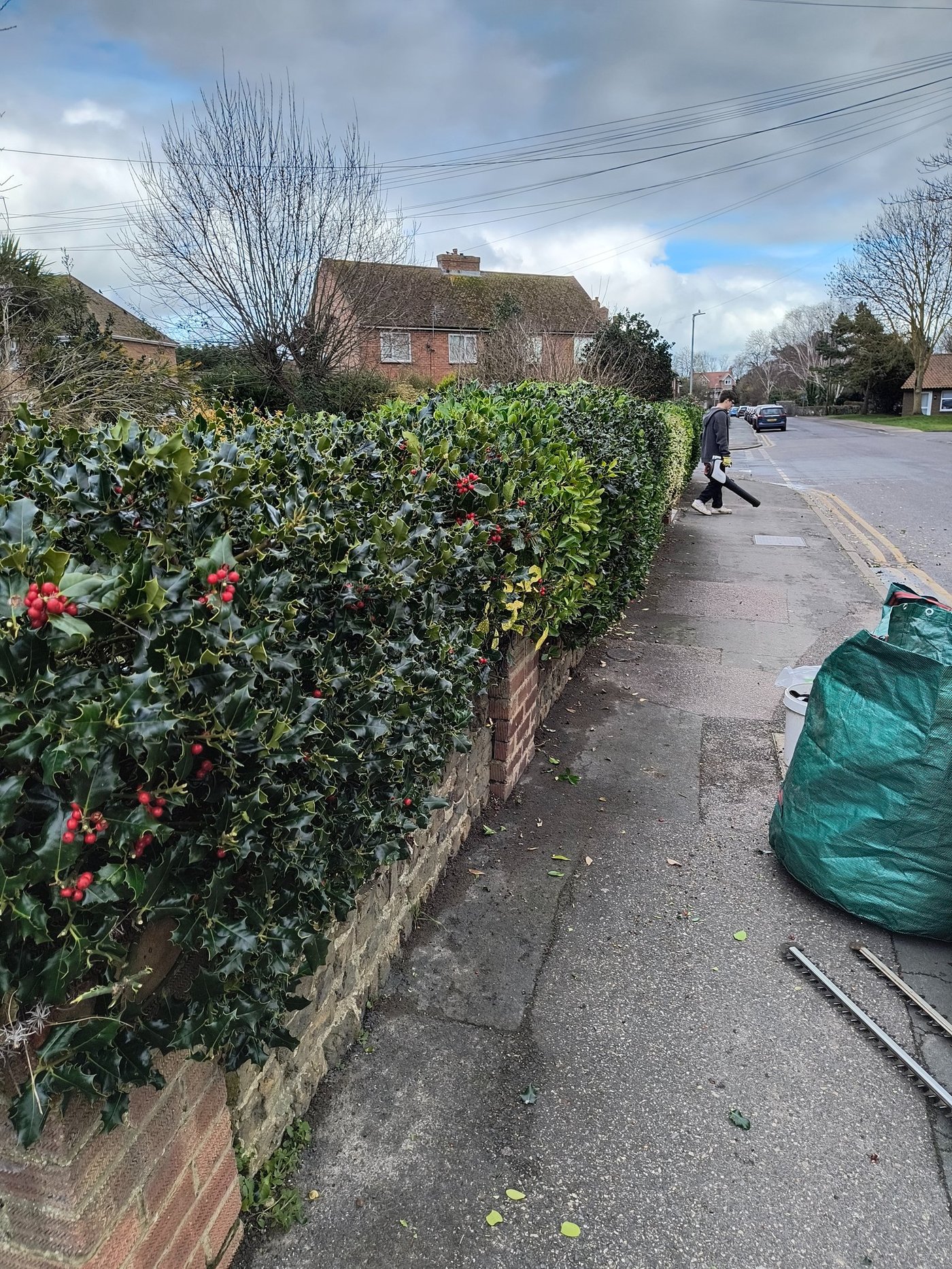
Escallonia comes from South America originally, but it has settled into British coastal gardens so completely that it can look as though it belongs. In Sandwich Bay, along the seafront in Deal, outside houses in Eastry: you will find escallonia hedges looking perfectly at home, shrugging off salt wind and producing their small tubular flowers in reliable abundance through the second half of summer.
The question we are asked most often about escallonia is whether it is safe to trim it and keep the flowers at the same time. The answer is yes, but the timing of your cut is everything. The comparison below sets out the two approaches.
Nesting season: the complication for escallonia
Escallonia flowers from June to September, which is almost exactly the period covered by the UK Wildlife and Countryside Act 1981, which makes it an offence to damage or destroy an active bird's nest. Nesting season runs roughly 1 March to 31 August. Escallonia is used for nesting cover, so the safest time to cut is September onwards, after both the main flowering period and nesting season have ended. Any summer trim carries both the risk of cutting active nests and of losing late flowers. Always check carefully before cutting between March and August.
Before you start: safety
Before you start the cut
Wear eye protection, sturdy gloves and ear defenders if using a petrol trimmer. Use a long-reach pole trimmer from the ground rather than a ladder wherever the hedge height allows. If a ladder is needed, have someone footing it and do not overreach sideways. Plug any corded electric trimmer into an RCD adaptor. Check for wasp nests before starting.
Formal tight trim vs natural open style: which suits your escallonia?
The biggest decision for an escallonia hedge is not which tool to use but what shape you are aiming for. These two approaches produce very different results for both appearance and flowering:
| Formal tight trim | Natural open style |
|---|---|
| Clipped to a straight, flat face each year | Lightly shaped to follow the plant's natural arching habit |
| Dense, even surface; looks neat year-round | Looser, more informal; more flower-bearing stems per year |
| Fewer flowers: trimming removes buds | More flowers: fewer buds removed per cut |
| Cut once per year, September | Cut once per year, September; occasional tip removal in July |
| Best for boundary hedges where tidiness matters | Best for garden borders and mixed hedges |
| Tool: hedge trimmer | Tool: hand shears or light trimmer pass |
For most garden hedges in Sandwich and Deal, the formal tight trim is the right choice: it gives you a tidy boundary that does not overwhelm neighbouring gardens, and the flowers are still produced in good numbers each year even on a clipped face.
When to cut: a direct comparison
| Timing | What you gain | What you lose |
|---|---|---|
| July (light tips only) | Neater appearance mid-summer; some control of growth | Some late summer flowers; risk of disturbing late nests |
| September (main cut) | Full flower display preserved; nesting season safely past | Hedge looks a little loose through August |
| October or November | Absolutely safe, full flower season enjoyed | Less time to settle before winter; avoid in a hard frost |
| Spring (March-April) | Only if renovation is needed | The whole summer's flowers; can delay recovery by a season |
September is the sweet spot. Flowering has largely finished, nesting season is over, and the plant has time to harden off new growth before winter. This is our standard recommendation for escallonia hedges across East Kent.
Which varieties work best in East Kent?
Not all escallonias are equally suited to exposed coastal conditions or to formal hedge work. Here is a brief run-down of the most common varieties we encounter:
Escallonia 'Red Hedge'. Dense, upright growth with bright crimson flowers. Excellent for coastal exposure and formal hedge work. Very common in Deal and Sandwich Bay. Reliable and fast to establish.
Escallonia 'Apple Blossom'. A more restrained grower with pale pink and white flowers. Suits smaller gardens in Worth, Ash and Woodnesborough where a large hedge would be too much. Slightly less wind-tolerant than 'Red Hedge' on very exposed seafront positions.
Escallonia 'Iveyi'. Large, vigorous and produces white flowers in abundance. Very good in coastal conditions. Grows faster than the others and needs more frequent trimming to stay in shape, but rewards the effort with the most impressive flower display of the three.
Escallonia 'Pride of Donard'. Deep rose-red flowers. Slightly more formal in habit than 'Iveyi'. Less commonly seen in this part of Kent but works well in exposed sites.
Renovation: how hard can you cut escallonia?
If an escallonia hedge has grown significantly out of its allotted space, a hard renovation cut is achievable but costs you flowering time. Cut back to the framework you want in late March, once the risk of hard frost has passed. The plant will produce strong new growth through the growing season, but flowering in the first year after a hard cut will be much reduced: the plant needs a full growing season to set new flower buds on the renovated growth. By the following year, flowering is usually back in good quantity.
If height is the issue and a neighbour is involved, our guide to hedge heights and the law covers what the legislation allows and how to approach a formal complaint if needed.
Hopes Grove Nurseries on escallonia
Hopes Grove Nurseries, the UK's largest specialist hedging grower with over 70 acres of hedging plants in production in the Weald of Kent, has a short demonstration video showing how to trim escallonia to maintain its shape and encourage fresh growth: Trim back the Escallonia to maintain its shape on the Hopes Grove Nurseries YouTube channel.
Escallonia and wildlife
Escallonia's long flowering season, June through September, makes it genuinely valuable for pollinators. Bees work the flowers consistently through the summer and into early autumn when other flowering hedges have finished. Given the overlap with nesting season, this is exactly why a September trim, after the main season ends, is the right call: you preserve both the flowers for insects and the cover for nesting birds through the critical months.
Our guide to wildlife-friendly hedge trimming covers the nesting season timing in more detail, with advice on how to check for active nests before cutting.
Rather we handled it?
We cut escallonia hedges across Sandwich, Deal, Worth, Ash, Woodnesborough, Eastry and Sandwich Bay. Send a photo for a free quote. Most jobs booked in within the week.
Related guides
Choosing a hedge species for Kent gardens
How escallonia compares to griselinia, privet and the other main choices for coastal and village positions in East Kent.
Read the guide WildlifeWildlife-friendly hedge trimming
Nesting birds, pollinators and the law that protects both. When to cut flowering hedges, and when to wait.
Read the guide