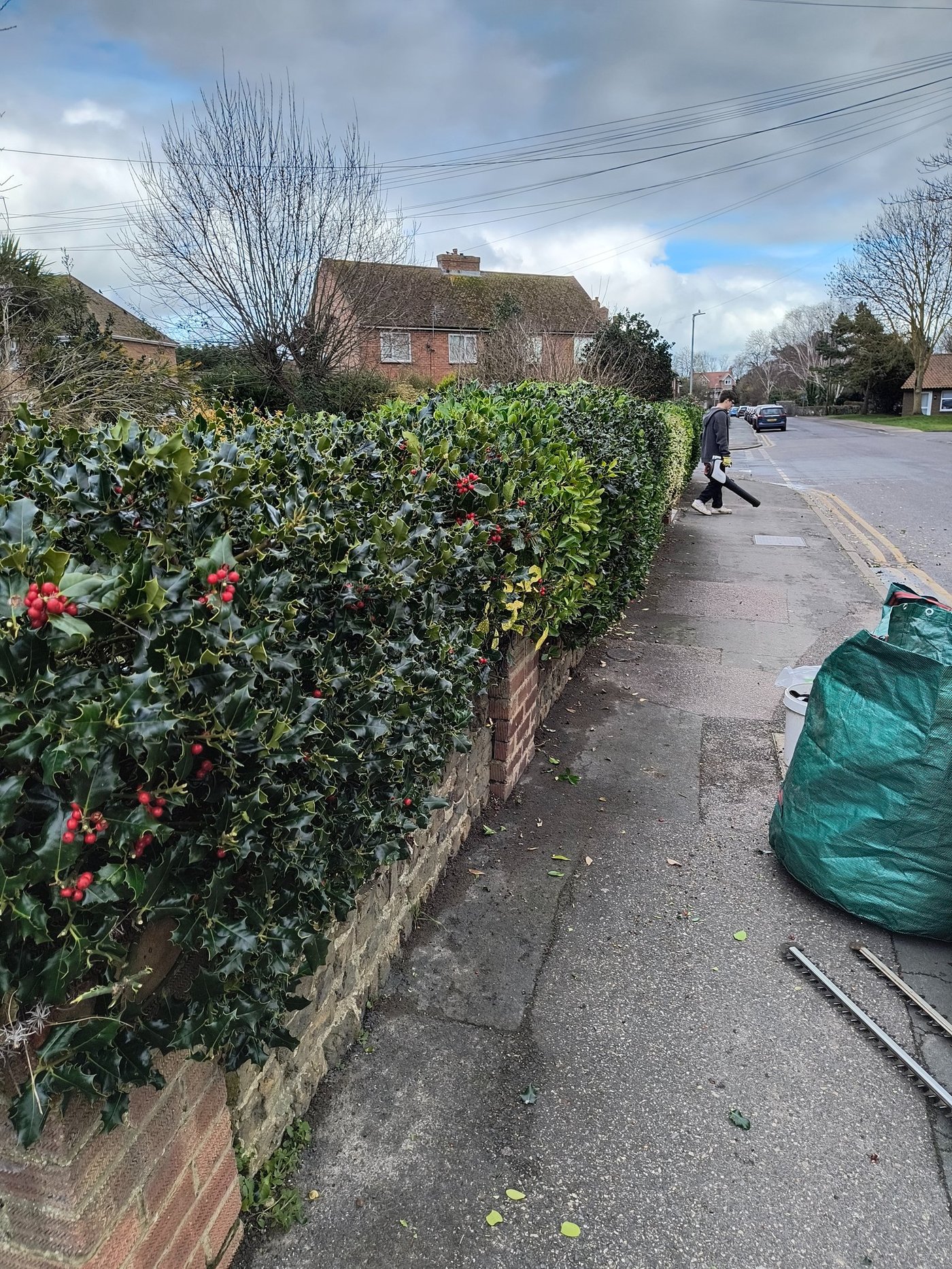
Branches from a neighbour's hedge crossing your boundary are one of the most common sources of garden disputes in England. The law does give you a remedy, but it is a narrower right than many people assume, and ignoring the qualifications can turn a simple trimming job into a civil or even criminal matter.
This guide covers the distinct legal question of overhanging branches and encroaching roots. If your issue is a hedge that is blocking light or outlook rather than crossing your boundary, that is a separate route under the High Hedges Act 2003 -- see our guide on hedge heights and neighbour law for that.
This guide is general information, not legal advice
Neighbour disputes can escalate quickly. If your situation involves significant property damage, a formal dispute or you are unsure about any of the decisions below, consult a solicitor who handles property or boundary matters. The Citizens Advice Bureau can point you to free initial guidance.
Decision 1: Does the hedge actually belong to your neighbour?
Before anything else, establish who owns the hedge. In England, a boundary hedge is usually owned by the person on whose land the main trunk or root mass sits. Check your title deeds or the Land Registry title plan: boundaries shown by a "T" mark on the plan indicate which side owns and is responsible for that boundary feature.
If the hedge sits exactly on the boundary line (common in older terraced properties in Sandwich and Deal), ownership may be shared, or the deeds may be silent. In that case, neither neighbour has a unilateral right to remove or drastically alter the hedge, and agreement is needed for any significant work.
If the hedge belongs to your neighbour: proceed to Decision 2.
If ownership is unclear or shared: speak to your neighbour first. If agreement cannot be reached, seek advice before cutting.
Decision 2: Are branches or roots actually crossing your boundary?
The common law right of abatement of nuisance allows you to cut back vegetation that encroaches onto your property. "Encroachment" means branches that physically cross into your airspace above your land, or roots that grow under your boundary and into your soil.
A hedge that is entirely on your neighbour's side of the boundary, even if it is very large or very close to the line, does not cross your boundary. You have no right to cut it, and cutting it without permission would be criminal damage.
Similarly, the right is limited to cutting back to the boundary line. You cannot cut branches on your neighbour's side of the line, even if you consider them unsightly or dangerous. Cutting beyond the boundary is damage to your neighbour's property.
If branches or roots are crossing your boundary: proceed to Decision 3.
If they are not crossing: you have no right of abatement. Talk to your neighbour or seek advice if the hedge is causing another problem.
Decision 3: Is there a Tree Preservation Order, or are you in a Conservation Area?
Even where your right of abatement applies, some hedges and trees carry additional legal protections that affect what you must do before cutting.
Tree Preservation Orders (TPOs). A TPO can be placed on individual trees or groups of trees by the local planning authority. Canterbury City Council covers Sandwich, and Dover District Council covers Deal and the surrounding villages. You can check whether a specific tree or hedge has a TPO via the council's online planning map, or by calling the council's tree officer. Where a TPO exists, you must notify the council before carrying out any cutting work. You do not need formal consent to exercise the right of abatement on branches crossing your boundary, but you must notify first and keep a written record. Cutting beyond the boundary on a TPO-protected tree without consent carries an unlimited fine.
Conservation Areas. If the property is in a Conservation Area, additional rules apply to any tree with a trunk diameter over 75mm (roughly the width of a tennis ball) measured at 1.5 metres from the ground. You must give six weeks' written notice to the local authority before doing the work. The notice period lets the council decide whether to make a TPO. Sandwich town centre -- including the area inside and around the medieval walls -- is a designated Conservation Area. Parts of Deal seafront and several East Kent village centres, including Ash, also fall within Conservation Area boundaries. Check with the council if you are unsure.
If no TPO and not in a Conservation Area: proceed to Decision 4.
If TPO or Conservation Area applies: notify the relevant council first. Then proceed to Decision 4 once the notification requirement is met.
Decision 4: Is there an active bird's nest in the branches you want to cut?
The Wildlife and Countryside Act 1981 makes it a criminal offence to damage or destroy an active bird's nest, or to disturb nesting birds. This law applies regardless of who owns the hedge and regardless of your common law right to cut.
Nesting season in England runs roughly from 1 March to 31 August. During this period, before cutting any hedge or tree, you must check for active nests. Look for birds flying in and out repeatedly, fresh droppings under the hedge, or newly built nests with eggs or young. If you find an active nest, you must leave the branch until the nest is abandoned.
The safe cutting window for most hedge and tree work is September to February. If your overhanging branch problem cannot wait (for example, a dead branch that poses immediate danger), take specialist advice before proceeding during the nesting period.
If no active nest: proceed to Decision 5.
If an active nest is present: wait until September at the earliest, when the nest is certain to have been abandoned. Check again before cutting.
Decision 5: What do you do with the cut material?
This is where many otherwise perfectly lawful trimming jobs create unnecessary disputes. The law is clear: the cut material (branches, roots, leaves, berries) belongs to your neighbour, not to you. You exercised your right to remove the nuisance from your property; you did not acquire ownership of the vegetation in doing so.
In practice, you should:
- Stack the cut material neatly on your side of the boundary.
- Tell your neighbour the material is there and offer to return it to them.
- If they say they do not want it, you may then dispose of it yourself.
- Do not throw the cut material back over the boundary fence without asking -- this is fly-tipping on a neighbour's land and may itself be an offence.
Most neighbours in East Kent will simply say "just compost it" or "put it in the green bin", and that is the end of the matter. The important thing is that you offered.
After cutting: offer the cut material to your neighbour. Dispose of it only if they agree or do not respond within a reasonable time.
One situation where the normal rules do not apply: dangerous trees
If a branch from your neighbour's hedge or tree is dead, diseased or structurally compromised, and poses an immediate risk of falling onto your property or a person, a more urgent approach may be justified. Write to your neighbour (keep a copy) describing the danger and asking them to deal with it. If they do not act and damage results, they may be liable. For a branch that is in immediate danger of falling, contact the council's emergency tree line or a professional contractor rather than cutting it yourself without warning.
When talking to your neighbour first is simply better
The right of abatement exists, but the best results in boundary disputes nearly always come from a conversation. In the close-knit towns and villages of East Kent -- where you are likely to remain neighbours for many years -- a short, friendly discussion about the hedge almost always lands better than arriving with a saw unannounced. The law is a backstop, not a first resort.
If relations are already difficult, consider asking a mutual friend or a local mediation service to help. Kent County Council's community mediation service offers free or low-cost support for exactly these situations.
The RHS (Royal Horticultural Society) has published a video on the legal and practical aspects of neighbour disputes involving trees and hedges, covering the right of abatement, TPO checks and what to do when agreement breaks down. Worth watching before you start any work on vegetation near a shared boundary: Neighbour disputes: trees and hedges on the RHS YouTube channel.
Need a contractor to handle the cutting?
If the overhanging branches are too large or too high to cut safely yourself, we cover hedge and tree work across Sandwich, Deal, Worth, Ash, Woodnesborough, Eastry and Sandwich Bay. We know the local TPO and Conservation Area boundaries well. Send a photo for a free quote.