At a glance: what you need to do
- Choose your native species mix (hawthorn is the backbone; add blackthorn, field maple, dog rose, holly or spindle for variety).
- Order bare-root whips for November to March delivery, when they are cheapest and establish fastest.
- Mark out the line, clear perennial weeds from a 60 cm strip.
- Dig a trench or individual holes and plant in a staggered double row at 3 to 5 plants per metre.
- Mulch with a 10 cm layer of bark or wood chip, kept clear of the stems.
- Protect against rabbits and deer if either are present on your boundary.
- Cut plants back by about a third immediately after planting to encourage bushy growth from the base.
If you have a boundary in East Kent that needs a hedge and you are thinking about what to plant, a mixed native hedgerow is usually the right answer. It costs a fraction of a formal hedging plant by the metre, it is adapted to local conditions, and it provides far more habitat value than any ornamental alternative.
The hedgerows you see along the lanes around Woodnesborough, Ash and the agricultural ground between Eastry and Sandwich Bay are largely hawthorn and blackthorn with field maple, dog rose and the odd spindle thrown in. Those hedges have been there for centuries for a reason: they are right for this part of Kent.
Nesting season: why winter planting is also the right time ecologically
Bare-root planting season (November to March) conveniently falls outside the main nesting period. Once your hedge is established, under the Wildlife and Countryside Act 1981, it is an offence to damage or destroy an active bird's nest. Nesting season runs roughly from 1 March to 31 August. Do not cut or trim an established native hedge in this window without checking it carefully for active nests first. The safe trimming window is September to February.
Choosing your native species mix
Hawthorn (Crataegus monogyna)
The backbone of any Kent hedgerow. Fast-growing once established, fiercely thorny (which makes an effective stock and intruder barrier), and enormously valuable for wildlife: white blossom for insects in May, red haws for fieldfares, redwings and blackbirds through autumn and winter. Grows on chalk, clay and most other East Kent soils without complaint.
Blackthorn (Prunus spinosa)
Flowers even earlier than hawthorn (white blossom in March, before the leaves), providing one of the first nectar sources for early bees. The blue-black sloe berries in autumn are valuable for birds and, if you are that way inclined, for sloe gin. Very thorny. Spreads by suckers if left uncut, which is actually useful for knitting a hedge together quickly.
Field maple (Acer campestre)
Underused in garden hedges but superb. Reliable autumn colour (yellow to gold and sometimes orange-red), good on chalk and clay, tolerates shade reasonably well. Provides cover and nesting sites. Mixes well with hawthorn and blackthorn without competing too aggressively.
Dog rose (Rosa canina)
Scrambling habit means it needs taller neighbours to weave through, but the pink blossom in June and the bright red hips through autumn and winter are worth it. Valuable for insects, birds and small mammals. The hips persist through to January on a good year.
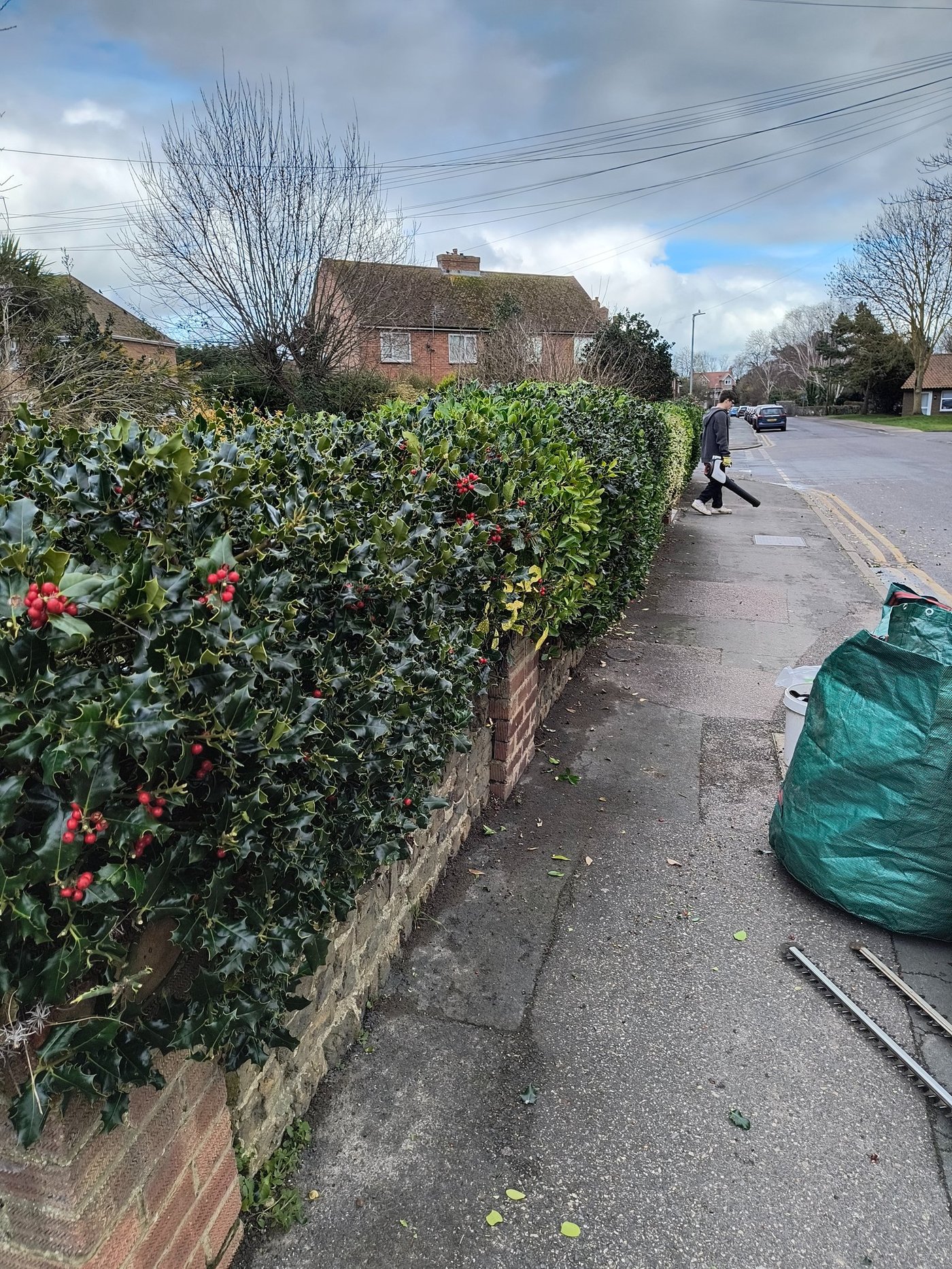
Holly (Ilex aquifolium)
Slow to establish from a bare-root whip but long-lived and extremely wildlife-friendly once it gets going: dense shelter for roosting and nesting birds, red berries for mistle thrushes in winter. On coastal and exposed East Kent boundaries, the evergreen density of holly is useful year-round. Plant a male and at least one female for berries.
Spindle (Euonymus europaeus)
The odd one in the mix that most people overlook. Vivid pink and orange fruits in autumn, brilliant autumn leaf colour, and an important food plant for the holly blue butterfly. Does well on the chalk soils of the North Downs and around the Sandwich area. Not as vigorous as hawthorn but adds biodiversity and colour to a mix.
Planting: the detail
When to plant
Order bare-root whips from a UK nursery for delivery from November onwards. In Kent, the mild coastal winters mean you can plant right through to March in most years, though January and February are the ideal months: the soil is workable, the plants are fully dormant, and they have the longest possible root-establishment period before their first growing season. Avoid planting in frozen or waterlogged ground.
Preparing the ground
Clear a strip at least 60 centimetres wide of perennial weeds. Couch grass and bramble roots in particular will compete hard with new bare-root plants in their first two years. You can use a hoe repeatedly in late summer before planting, or cover the strip with black plastic or cardboard well in advance to kill off the weeds. A rough digging of the strip to break up compacted soil helps, but do not over-cultivate: native hedgerow plants are not fussy.
How to plant
Plant in a staggered double row. Two rows, roughly 30 to 40 centimetres apart, with plants offset between the rows like a zigzag rather than in straight lines side by side. This produces a thicker, more natural-looking hedge than a single row, and fills in faster.
Plant spacing: 3 plants per metre for a more relaxed, informal hedge; 5 plants per metre for a dense boundary that fills in within two or three years. For a typical mixed native hedge, 4 per metre works well. Dig a hole just large enough to take the roots spread out naturally, firm in well, and water if the soil is dry.
Ashridge Nurseries, one of the UK's leading specialists in bareroot hedging plants (founded 1949), have a useful video guide to planting a traditional native country hedge:
Video: "How to Plant a Bareroot Native Country Hedge" by Ashridge Nurseries, a Somerset-based UK mail-order plant nursery established in 1949 and one of the UK's largest suppliers of bareroot hedging. Watch on YouTube.
Mulching
After planting, apply a 10 centimetre layer of bark chippings or composted wood chip around the plants, in a strip covering the full planted area. Keep the mulch clear of the plant stems (leave a couple of centimetres of gap). Mulch suppresses weeds, retains moisture and moderates soil temperature. This step makes a significant difference to establishment, particularly on the sandy and chalk soils around Sandwich and Sandwich Bay where moisture retention is an issue in dry summers.
Protecting against rabbits and deer
If rabbits are present, fit individual tree shelters (spiral guards or tubes) on each plant. Rabbits will strip the bark from bare-root whips in winter and kill them. Deer cause the same damage on a larger scale. On rural boundaries around Worth, Ash and Woodnesborough, rabbit guards are a sensible precaution.
Formative pruning
Immediately after planting, cut each whip back by roughly a third. This looks alarming but it is the right thing to do: it forces growth from the base, which is what produces a dense, bushy hedge rather than a leggy, sparse one. In year two, cut back the side shoots again by a third in winter. By year three you should have a hedge that is beginning to knit together properly.
What to expect in years one to five
Year one: not much to look at. The plants establish roots, not top growth. Some may look almost dead in summer. Give them time. Year two: noticeably more growth, the first real impression of a hedge forming. Year three: the hedge begins to fill in. Year four or five: a proper hedge, with the hawthorn and blackthorn beginning to overlap and knit together. From here it needs only an annual cut (between September and February) to keep it at the right size.
Once the hedge is established, you may notice increased bird activity almost immediately. A dense hawthorn hedge provides exactly the type of low, thorny cover that robins, dunnocks and wrens need for nesting. See our wildlife-friendly trimming guide for how to manage an established native hedge without disturbing birds or other wildlife.
If you are wondering which species to prioritise for your particular soil or setting in East Kent, our hedge species guide for Kent gardens covers the main options in more detail.
The hedge you plant in November looks like a collection of sticks. By May it has leaves. By the following autumn the blackthorn is already beginning to do something. Give it three years and you will wonder why you left it so long.
Got a question about what to plant?
We do not plant new hedges ourselves (it is a different trade) but we are happy to chat about what would suit your boundary. Email hello@sandwichhedges.co.uk with your question.
Related guides
Choosing a hedge species for Kent gardens
Coastal, clay, chalk or shaded, different spots want different species. What to pick for your part of East Kent.
Read the guide WildlifeWildlife-friendly hedge trimming
Once your hedge is established and nesting birds move in, here is how to trim it without disturbing them.
Read the guide