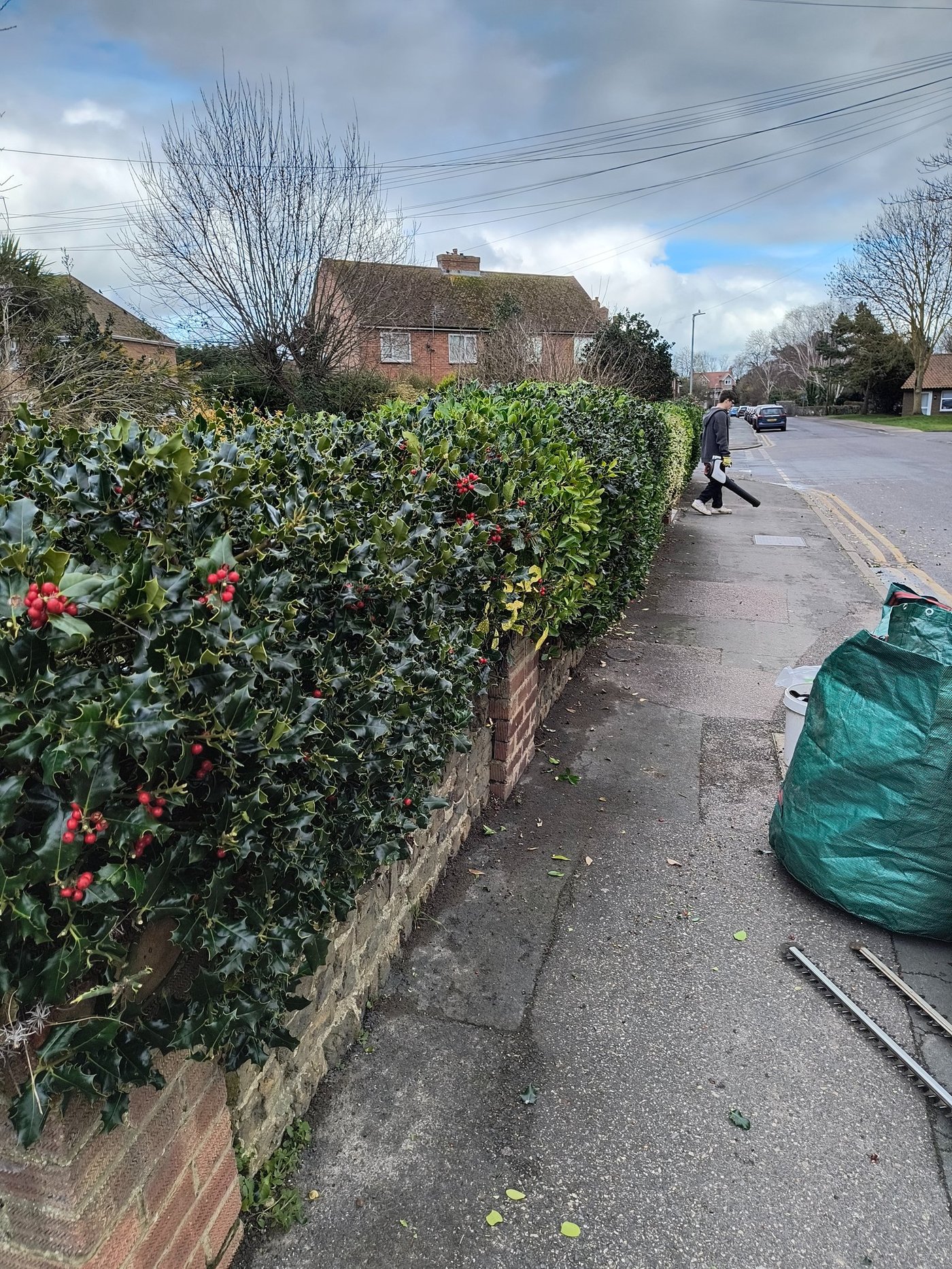
Both plants are grown extensively along the Deal and Sandwich Bay seafront, in the exposed front gardens of Woodnesborough and Eastry, and in coastal village gardens where a privet or box would struggle with salt spray and wind. If you have one and are wondering when to trim it, or if you are choosing between them, here is what we see in practice.
Elaeagnus vs Griselinia: side by side
| Feature | Elaeagnus x ebbingei | Griselinia littoralis |
|---|---|---|
| Leaf | Large, leathery, silvery-green above, silver beneath | Smaller, bright apple-green, glossy |
| Growth rate | Fast: 45-60 cm per year in good conditions | Moderate-fast: 30-45 cm per year |
| Salt tolerance | Excellent: handles direct coastal exposure | Excellent: originally from coastal New Zealand |
| Frost hardiness | Good to around -10°C; leaf scorch in severe frost | Less frost-hardy; can defoliate below -8°C |
| Flowers | Tiny, intensely scented, October-November | Inconspicuous; not a feature |
| Best trimming time | Late May to June (after frost risk, before autumn flowers) | May to August; one cut a year is enough |
| Formal finish | Acceptable; large leaves show cut marks more | Slightly better; smaller leaves give a cleaner edge |
| Renovation | Tolerates hard cutting; breaks from old wood | Tolerates hard cutting; best done in stages |
| Best use case | Fast windbreak and screen; scent in autumn | Formal evergreen screen; bright colour year-round |
When to choose Elaeagnus
Elaeagnus x ebbingei is the faster choice. If you need height quickly on an exposed coastal site, want a screen that will establish within two or three seasons, and are prepared to trim once or twice a year to keep it in check, Elaeagnus is usually the right answer.
The autumn flowers are a genuine bonus that surprises most people. Elaeagnus flowers in October and November, when almost nothing else is flowering. The blossoms are tiny and easy to miss against the foliage, but the scent carries strongly and attracts late bees and other pollinators at a time of year when they are running short of food. This is worth factoring into your trimming timing: do not cut in October or November and sacrifice the scent and the late-season pollinator value.
Elaeagnus is also more frost-hardy than Griselinia when tested hard. In the exposed gardens along Sandwich Bay and the Deal seafront, both perform well in most winters, but in a sharp freeze below about -8°C, Griselinia can defoliate while Elaeagnus holds its leaves. Kent's mild coastal climate means this matters less than it would inland, but it is worth knowing.
When to choose Griselinia
Griselinia gives a brighter, more consistently green appearance through the year. The apple-green leaves are vivid in all seasons and catch the light better than Elaeagnus's more muted silver-green. For a front garden in Sandwich or Deal where the hedge faces south and you want colour and tidiness rather than just a windbreak, Griselinia often looks better.
The smaller leaf also makes Griselinia a more forgiving plant to trim. Elaeagnus's large leaves show individual cut marks on the surface; with Griselinia the smaller leaves blend into a cleaner finished surface after the trimmer passes over them. For a formal clipped hedge at a consistent height and width, Griselinia is slightly easier to maintain to a sharp outline.
See our full guide to Griselinia hedge care in Kent for trimming detail on that species.
Trimming Elaeagnus: timing and method
Nesting season
The UK Wildlife and Countryside Act 1981 makes it an offence to damage or destroy an active bird's nest. Nesting season runs roughly 1 March to 31 August. Elaeagnus hedges provide good nesting cover. Always check carefully before trimming. The safest trimming window is after 31 August and before 1 March. A late May to mid-June cut falls within nesting season, so check first.
Before you start
- Gloves and eye protection: Elaeagnus has occasional small spines on some cultivars and the cut leaves can be sharp-edged. Wear gloves and safety glasses.
- Electric trimmers and RCDs: always plug a corded trimmer in via a residual current device (RCD) and trail the cable away from your working direction.
- Ladders: Elaeagnus grows fast and established hedges can be tall. A pole trimmer or long-reach trimmer keeps you on the ground for hedges up to about 2.5 m. Use a stable platform ladder with someone footing it if you need to go higher.
Elaeagnus x ebbingei is fast-growing and can put on 45-60 cm in a single season in a sheltered, well-fed garden. One cut a year is usually sufficient to maintain a reasonable shape, but you may want a second light trim if the hedge is young and you are working hard to fill it in quickly.
Main cut: late May to mid-June
The ideal window is after the risk of hard spring frosts has passed and before the plant puts on its main summer extension growth. In East Kent this is typically mid-May onwards. Cut to your desired outline, taking back the previous season's extension growth. Because Elaeagnus grows vigorously, you can cut fairly firmly without worrying about removing too much.
This cut falls within nesting season. Check the hedge before you start and set the trimmer down if you find an active nest.
Second light trim: late August (optional)
If the hedge has put on a lot of growth through summer and looks untidy, a second light cut in late August keeps it tidy going into autumn. This is a tidy-up rather than a formative cut. Avoid cutting after September, as this is when the autumn flowers are developing and opening.
Leave October and November alone
The tiny, intensely scented flowers open in October and November on Elaeagnus x ebbingei. They are inconspicuous against the foliage but the scent is strong, sweet and carries on mild autumn evenings. Trimming during this period removes the flowers and the late-season pollinator value. Once the flowers fade (typically by late November or December), the hedge is ready for any additional tidying.
Renovation: cutting back an overgrown Elaeagnus hedge
Elaeagnus tolerates hard cutting and will regenerate reliably from old wood. If the hedge has spread considerably wider than you want or has developed a loose, uneven outline from irregular trimming, tackle it in late March or April. Cut back to the desired outline, reduce the height, and thin out the interior to improve light and airflow.
You can be quite aggressive: Elaeagnus will break new shoots from bare stems. Water during the first summer after a hard renovation cut and apply a general-purpose slow-release fertiliser around the base in spring. The hedge will respond within the same season and look presentable again by the following year.
In Kent's mild coastal climate, Elaeagnus in gardens around Deal, Sandwich Bay, Woodnesborough and Eastry recovers quickly from renovation. It is one of the most forgiving hedges we cut.
For a coastal East Kent garden that needs a fast evergreen screen, Elaeagnus and Griselinia are both strong choices. The main thing that separates them is the autumn flowers and scent on the Elaeagnus, which is a genuine bonus in October.
Credit: the best4hedging channel's video on Elaeagnus hedging is a useful guide to the species from one of the UK's leading specialist hedging nurseries. You can find it on YouTube by searching for Elaeagnus hedge care or the channel name.
Rather we handled it?
We trim and shape hedges across Sandwich, Deal, Worth, Ash, Woodnesborough, Eastry and Sandwich Bay. Send a photo for a free quote, most gardens booked the same week.
Related guides
Griselinia hedge care in Kent
The go-to evergreen for exposed coastal gardens. Salt-tolerant, one cut a year, and very at home along the Deal and Sandwich Bay seafront.
Read the guide Planting & choosingChoosing a hedge species for Kent gardens
Coastal, clay, chalk or shaded: different spots want different species. Here's what to pick for your conditions.
Read the guide