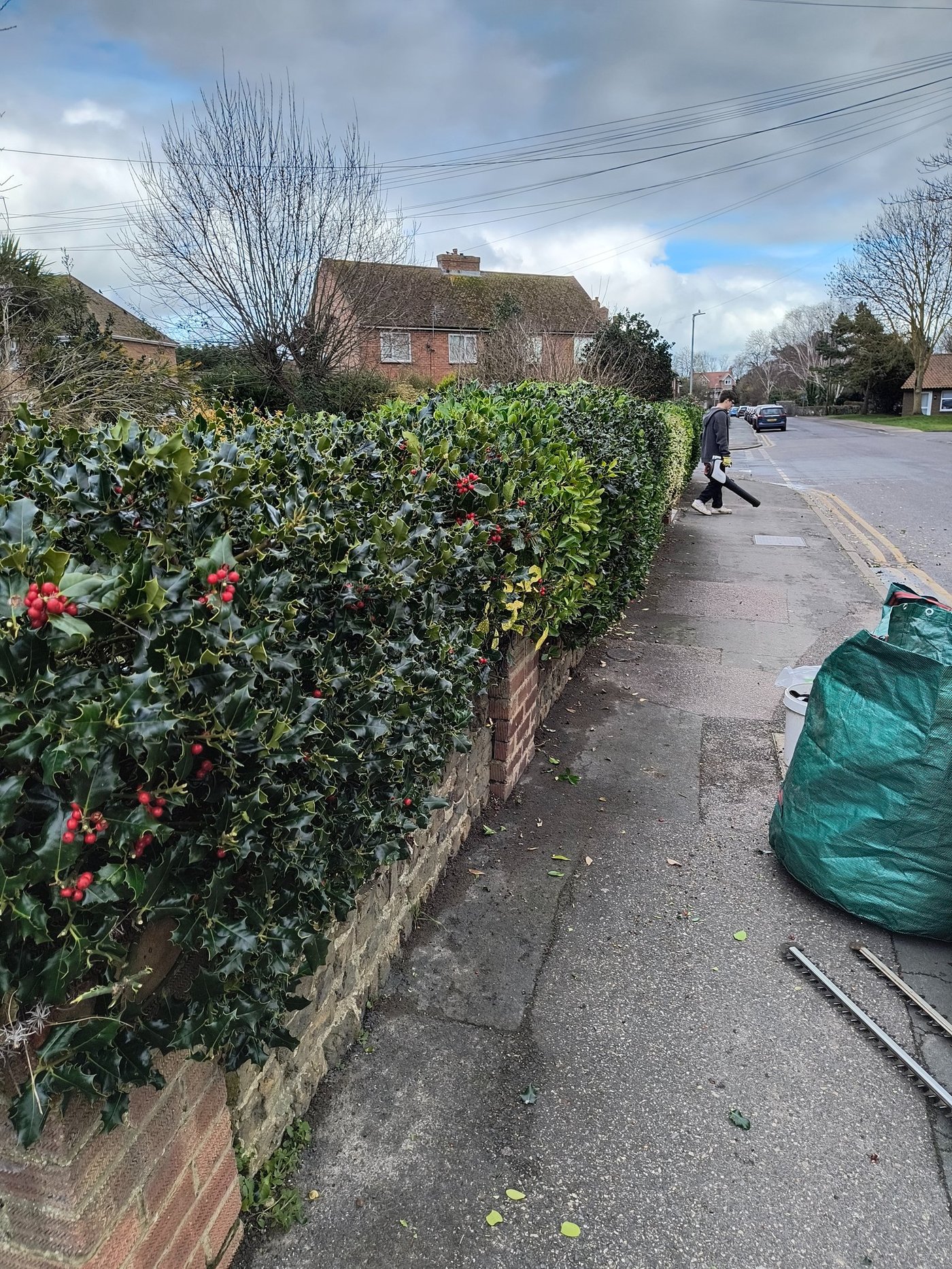
Hedges are permanent plantings. Unlike a vegetable bed you clear and replant each year, a hedge stays in the same ground indefinitely, competing for nutrients with lawn, borders and itself. Over time, even hedges on good soil can show signs that the ground is thinning out: slower growth, yellowing leaves, thin patches, or a general sparseness that trimming alone does not fix. A feed at the right time usually solves all of these.
What NPK means for a hedge
Fertiliser bags carry an NPK rating: three numbers showing the percentage of nitrogen (N), phosphorus (P) and potassium (K) in that order. For hedges, here is what each does in practice:
- Nitrogen (N): drives leafy, green growth. The main nutrient for a hedge that is growing too slowly or looks pale and thin.
- Phosphorus (P): supports root development. Useful when establishing a new hedge or when the root zone has been disturbed.
- Potassium (K): improves hardiness and disease resistance. Higher-potassium feeds in late summer help a hedge build up reserves before winter.
For most established hedges, a balanced or slightly nitrogen-forward fertiliser in spring works well. Something in the range of NPK 7-5-5 or 6-4-4 gives a steady push into the growing season without forcing an unnaturally rapid flush of soft growth that is harder for the plant to support.
Comparing your main options
| Type | How it works | Best for | Main drawback |
|---|---|---|---|
| Compost mulch | Slow breakdown by soil organisms; releases nutrients over months or years | Sandy or chalky soils; improving long-term soil structure; weed suppression | Unpredictable NPK; won't rescue a hedge fast |
| Farmyard manure | Similar to compost but higher in nitrogen; must be well-rotted before use | Improving thin, hungry ground; annual mulch on heavy-growing species | Can burn roots if fresh; not ideal close to stems |
| Blood, fish and bone | Organic granular; faster than compost; releases over several weeks | Spring feed on established hedges; post-renovation recovery | Needs moisture to activate; attracts foxes and badgers if not worked in |
| Slow-release granules (synthetic) | Coated pellets release nutrients triggered by soil temperature and moisture; lasts 3-6 months | One-and-done spring treatment; consistent delivery without repeat applications | More expensive per bag; no soil-structure benefit |
| Liquid fertiliser | Water-soluble concentrate; immediately available to roots | Fast rescue of a struggling hedge; foliar feed for trace-element deficiencies | Short-lived; needs repeat applications; easy to over-apply |
| Ericaceous fertiliser | Acid-forming; lowers pH around roots | Acid-loving species on alkaline chalk soils: box, yew (in chalk gardens) | Wrong choice for most hedges; harms species that prefer neutral-alkaline soil |
When to feed
Spring: the main window
Late February to April is the primary feeding window. The hedge is coming out of dormancy and is about to put on its main flush of growth. A feed applied now goes directly into that growth push. Apply blood, fish and bone or a slow-release granular fertiliser at the rate on the packet, scratched lightly into the soil around the drip line of the hedge (roughly the outer edge of the canopy, not hard against the stems). Water in if conditions are dry.
A compost or well-rotted manure mulch applied at the same time, 5-10 cm deep and kept clear of the stems, does double duty: it feeds slowly through summer and retains moisture during Kent's often dry spring and early summer.
Late summer: the recovery feed
July to August is the second opportunity. After trimming, hedges divert energy into healing cuts and producing new growth. A light feed at this point supports that recovery. Use a lower-nitrogen, higher-potassium product at this time of year (some manufacturers label these as "autumn" feeds). The potassium helps the hedge build up reserves before winter rather than producing soft leafy growth that would be vulnerable to an early frost.
Avoid feeding after August. Late feeding pushes growth that does not harden off before cold arrives, and that soft growth is the first thing to suffer in a hard autumn or winter.
No feed needed in autumn and winter
From September onwards, most hedges do not need or benefit from feeding. The exception is a mulch of compost or well-rotted manure applied as a winter top-dress, which will break down slowly over the following months and be ready to support spring growth. That is not really a feed so much as a soil improvement: it has no immediate effect but banks nutrients for the year ahead.
Which hedges benefit most from feeding
In East Kent, the hedges that show the clearest response to feeding are those growing on the thin, free-draining soils found in the villages inland from Sandwich: Ash, Woodnesborough, Eastry and the surrounding farmland. The chalk and sandy loam in these areas drain freely and leach nutrients faster than heavier clay. A hedge that would look after itself in a heavier Sussex or Surrey garden may genuinely need an annual feed here.
Heavy feeders that respond well: Leylandii and other fast-growing conifers, laurel (Cherry and Portuguese), hawthorn, field maple, hornbeam. These put on substantial growth each year and deplete soil nutrients quickly, especially in competition with neighbouring lawn.
Light feeders that manage on little: yew, box (both are naturally slow-growing and prefer not to be pushed), privet on reasonable soil. Over-feeding yew or box can produce rapid soft growth that loses the tight, dense character that makes them worth growing.
Newly planted hedges in their first year benefit from a spring feed and a compost mulch to help establishment, but should not be pushed hard with high-nitrogen fertiliser. The priority in year one is root development, not top growth.
Kent soil and pH considerations
Much of East Kent sits on chalk, greensand or a mix of the two. Chalk soils are alkaline (typically pH 7.5-8.0) and free-draining. On these soils, some nutrients become less available to plants even if physically present in the soil: iron and manganese in particular can become locked up at high pH, leading to yellowing leaves (chlorosis) that looks like nitrogen deficiency but does not respond to a nitrogen feed.
If your hedge shows pale or yellowing growth on alkaline soil and a standard feed does not improve it within a few weeks, the issue is likely pH-related nutrient lockup rather than a straight deficiency. Sequestered iron (a chelated iron product that remains available at high pH) applied as a liquid feed is often the right answer in this situation. It is available from most garden centres and can be applied as a drench or foliar spray.
Gardeners closer to the coast, around Sandwich Bay and Deal, are typically on slightly less alkaline ground and the issue arises less often, but it is worth knowing.
Organic vs synthetic: which is better?
The honest answer is that both work, and the right choice depends on what you value and how much time you want to spend. Here is a plain-English summary:
Organic feeds (compost, manure, blood fish and bone) release slowly, improve soil biology over time, and are less likely to cause problems from over-application. They are the better long-term investment for soil health. The main drawback is unpredictability: the nutrient content of compost and manure varies, and they need moisture and warmth to release, so a cold dry spring slows them down.
Synthetic slow-release granules (Osmocote, Growmore and similar) deliver a known and predictable NPK over a defined period. They are convenient, effective, and straightforward to apply. They do not improve soil structure and the manufacturing process has a higher environmental footprint than composting kitchen and garden waste.
Liquid fertilisers work fastest, which makes them useful for rescuing a hedge that is clearly struggling. They are the right tool for a specific short-term problem, not a substitute for a proper feeding programme.
For most hedge owners in East Kent, the most practical approach is: a blood, fish and bone or slow-release granular application in spring, plus a 5-10 cm compost or well-rotted manure mulch around the base, repeated each year. That covers the hedge's main nutritional needs without complexity and gradually improves the soil underneath.
Credit: BBC Gardeners' World Magazine's YouTube channel covers fertiliser application and general garden maintenance in detail. Search for the channel by name on YouTube.
Rather we handled it?
If your hedge is looking thin, sparse or slow-growing and you are not sure what it needs, we are happy to take a look when we are in the area for a trim quote. We cover Sandwich, Deal, Worth, Ash, Woodnesborough, Eastry and Sandwich Bay. Send a photo for a free quote, most gardens booked the same week.
Related guides
Composting hedge trimmings
What to do with the clippings after trimming. Which species compost well, what to avoid, and how to speed up the process.
Read the guide RestorationRenovating a neglected hedge
What to do when a hedge has been left to grow unchecked for years. How far you can safely cut back, and what to feed afterwards.
Read the guide