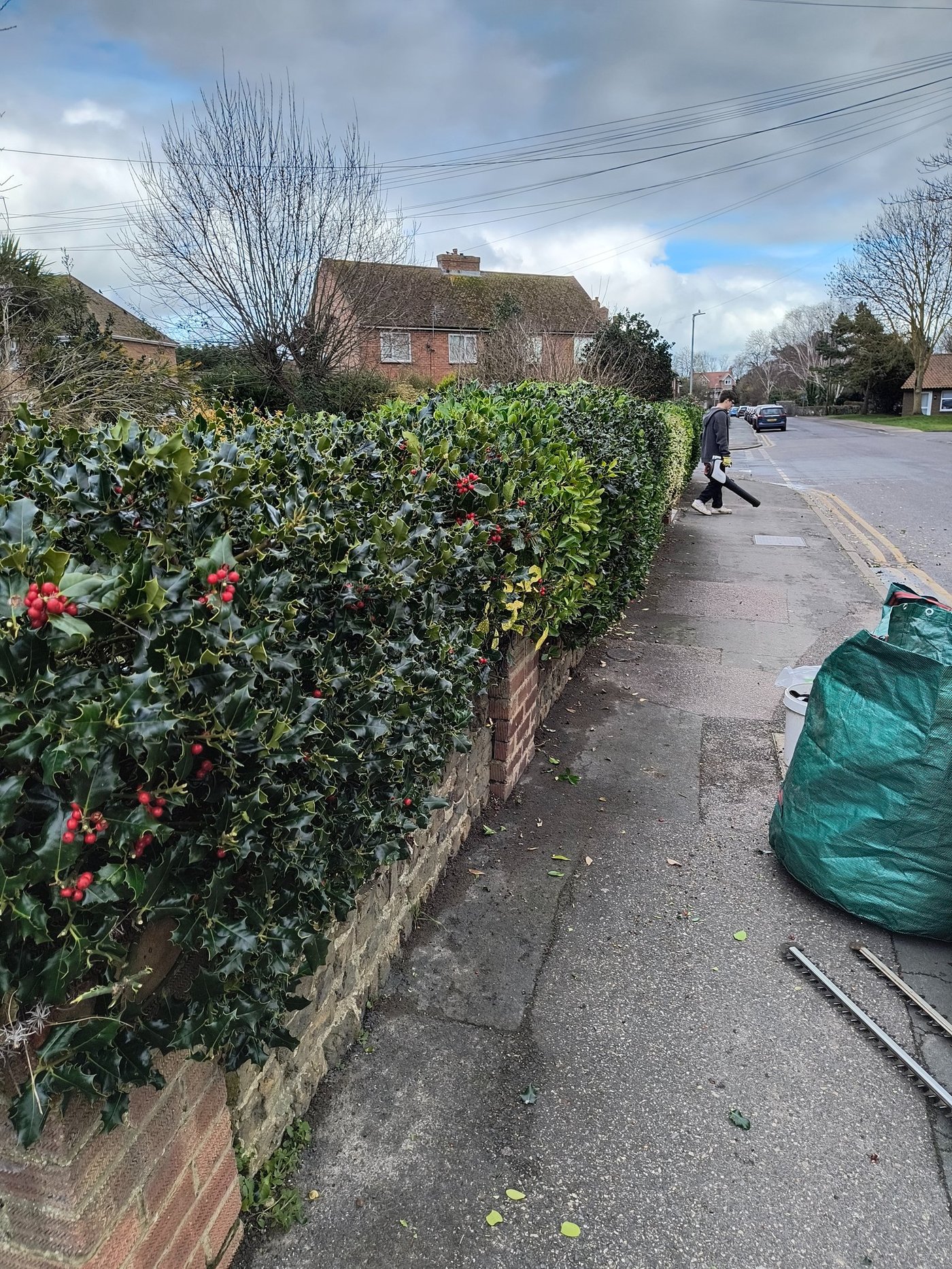
Summer checklist: hedge care from June to August
- Check for drought stress: wilting or curling leaves on deciduous hedges, bronzing on the south-facing side of evergreens, premature leaf drop. These are signs the hedge needs water.
- Water young hedges (under three years old) during any dry spell lasting more than two weeks. Established hedges on deep soil generally manage, but plants in chalk cuts or near Sandwich Bay coastal sand may need help.
- Apply a mulch of compost or bark around the base to retain moisture. Keep it 5 to 10 cm clear of the main stems to avoid rot.
- Do not heavy-trim a stressed hedge. A light tidy is fine. Major renovation cuts can wait until September, when the hedge is in better shape to recover.
- Do not fertilise with high-nitrogen products during a drought. It pushes soft new growth the plant cannot support without adequate water.
- Check for nests before any trimming between 1 March and 31 August. Nesting season is still in progress throughout summer. Active nests are protected under the Wildlife and Countryside Act 1981.
East Kent is relatively dry for England. Average annual rainfall in Sandwich and Deal is around 550 to 600 mm, compared to 750 mm for England as a whole. In a hot year, rainfall from May to August can be very low, and the well-drained chalk soils around Worth and Eastry and the sandy coastal soils near Sandwich Bay hold very little reserve.
Most mature hedges in decent deep soil cope well with this. But young hedges, and hedges on particularly thin or free-draining soil, can come under real pressure in a hot summer. Knowing when to act and what to do makes the difference between a hedge that comes through a dry spell in good shape and one that comes out of it with dead sections.
Which hedges are most vulnerable?
Young and recently planted hedges
Any hedge planted in the last two or three years has not yet developed the deep root system that allows an established plant to access soil moisture in dry conditions. Bare-root plants (usually planted in winter) typically establish well by their first summer, but in a hot, dry first season they may still need watering. Container-grown plants planted in spring are particularly vulnerable in a dry early summer as their roots have had less time to spread.
Hedges on thin chalk soils
The chalk downland soils around Worth, Ash and Eastry can have very little topsoil over solid chalk in some spots. Water drains through the thin surface layer quickly and the chalk beneath holds little. Hedges in these situations benefit most from regular mulching to build up organic matter and water retention over time.
Hedges near the coast on sandy soils
The sandy soils around Sandwich Bay, the Royal St George's area and parts of Deal near the seafront drain freely and hold almost no moisture. Established species like griselinia, escallonia and sea buckthorn are adapted to these conditions (one reason they are planted here), but privet, beech and leylandii hedges in exposed coastal positions can show drought stress faster than the same species in Ash or Woodnesborough.
Hedges against walls or in dry shade
A hedge growing close to a south-facing wall or fence sits in a rain shadow and receives more radiant heat than an open-ground hedge. The soil in these spots is often noticeably drier. Laurel, privet and photinia in these conditions may need occasional deep watering in a prolonged dry spell even when they are well established.
How to water a hedge well
A light daily sprinkle from a watering can is largely wasted: it wets the surface but does not penetrate to the root zone. Water deeply and infrequently instead.
The most effective method is a slow trickle from a hosepipe laid at the base of the hedge. Leave it running at low pressure for 20 to 30 minutes per 5 metres of hedge. This gets water down to where the roots are. Alternatively, a garden watering can with a long spout, filling the base channel generously every 10 to 14 days, is enough for most hedges in a dry period.
Water in the morning or evening, not in the heat of the day. Watering in bright midday sun does not burn leaves (this is a gardening myth) but much of the water evaporates before it reaches the roots.
Mulching to retain moisture
A 7 to 10 cm layer of mulch along the base of the hedge does more to protect against drought than occasional watering. Good materials include garden compost, well-rotted farmyard manure, mushroom compost, or bark chippings. Apply it in spring before the ground dries out, or any time you have it available. Keep the mulch a few centimetres away from the main stems to avoid encouraging rot at the base.
Over time, regular mulching builds up the organic matter content of the soil, improving both moisture retention and fertility. On the thin chalk soils of East Kent, this gradual soil improvement makes a real difference to how a hedge performs in hot summers. See our guide to feeding hedges for how to combine mulching with targeted fertiliser use.
On compost from hedge trimmings: see our guide to what to do with hedge trimmings for how to turn clippings into usable mulch material over a season.
Signs of drought stress to watch for
Leaf wilting in the afternoon: most plants wilt slightly in heat and recover overnight. If the hedge looks wilted in the morning too, the roots are genuinely struggling and water is needed.
Leaf scorch: brown, papery edges or patches on leaves, particularly on the south-facing side of the hedge. This often follows a combination of heat and drying wind rather than drought alone, but insufficient soil moisture makes it worse.
Premature leaf drop: deciduous hedges (beech, hornbeam, hawthorn) shedding leaves in July or August rather than October is a stress response. The plant is reducing its leaf area to lower its water demand. The hedge usually recovers fully in autumn and the following spring, but severe early defoliation weakens it.
Tip dieback on conifers: brown tips appearing over a wide area of a conifer hedge in summer may indicate drought stress, particularly on a south-facing side or after a very dry period. A small amount of tip bronzing is normal in autumn on some species (Thuja plicata does this regularly), but widespread browning in midsummer on a Lawson cypress or leylandii that was green in May is worth investigating.
What not to do in a summer drought
Do not hard-trim a visibly stressed hedge. Trimming removes foliage the plant needs for photosynthesis and compounds the stress. A light aesthetic tidy is fine. Renovation cuts, heavy reductions and major reshaping should wait until after rain returns, ideally until September when the growing season is past its peak.
Do not feed with high-nitrogen fertiliser. Nitrogen encourages soft, fast new growth, and a drought-stressed plant cannot support it without adequate water. Hold off on granular nitrogen feeds until conditions improve. A very dilute seaweed extract or balanced liquid feed in the watering can is supportive without pushing hard growth.
Do not assume browning means death. Most established hedges that look bad in August recover well in October and November when autumn rain arrives. Resist the urge to dig sections out until you have seen whether they recover after the first significant autumn rainfall.
After the drought: helping a hedge recover
Once rain returns, an established hedge generally recovers without much help. A few things make recovery faster:
- A feed of balanced slow-release fertiliser in early September gives the hedge nutrients to support root recovery and autumn growth.
- Apply a fresh layer of mulch to help retain the returning soil moisture.
- Leave dead-looking sections until at least November before deciding whether to remove them. Some sections that look dead in August are putting on new buds by October.
- For any section that is genuinely dead (no green growth anywhere on the stems by November), see our guide to renovating a neglected or patchy hedge for how to fill gaps.
BBC Gardeners' World Magazine covers summer garden care and drought management regularly on their YouTube channel, youtube.com/@BBCGardenersWorldMagazine, with practical advice aimed at UK climate conditions. Their seasonal content is good for understanding how drought affects different plant types across a garden, not just hedges.
Hedge looking poorly after a dry summer?
If sections have died back and you are not sure whether it is drought, disease or something else, we can take a look. We work across Sandwich, Deal, Worth, Ash, Woodnesborough, Eastry and Sandwich Bay. Get in touch for an honest assessment.