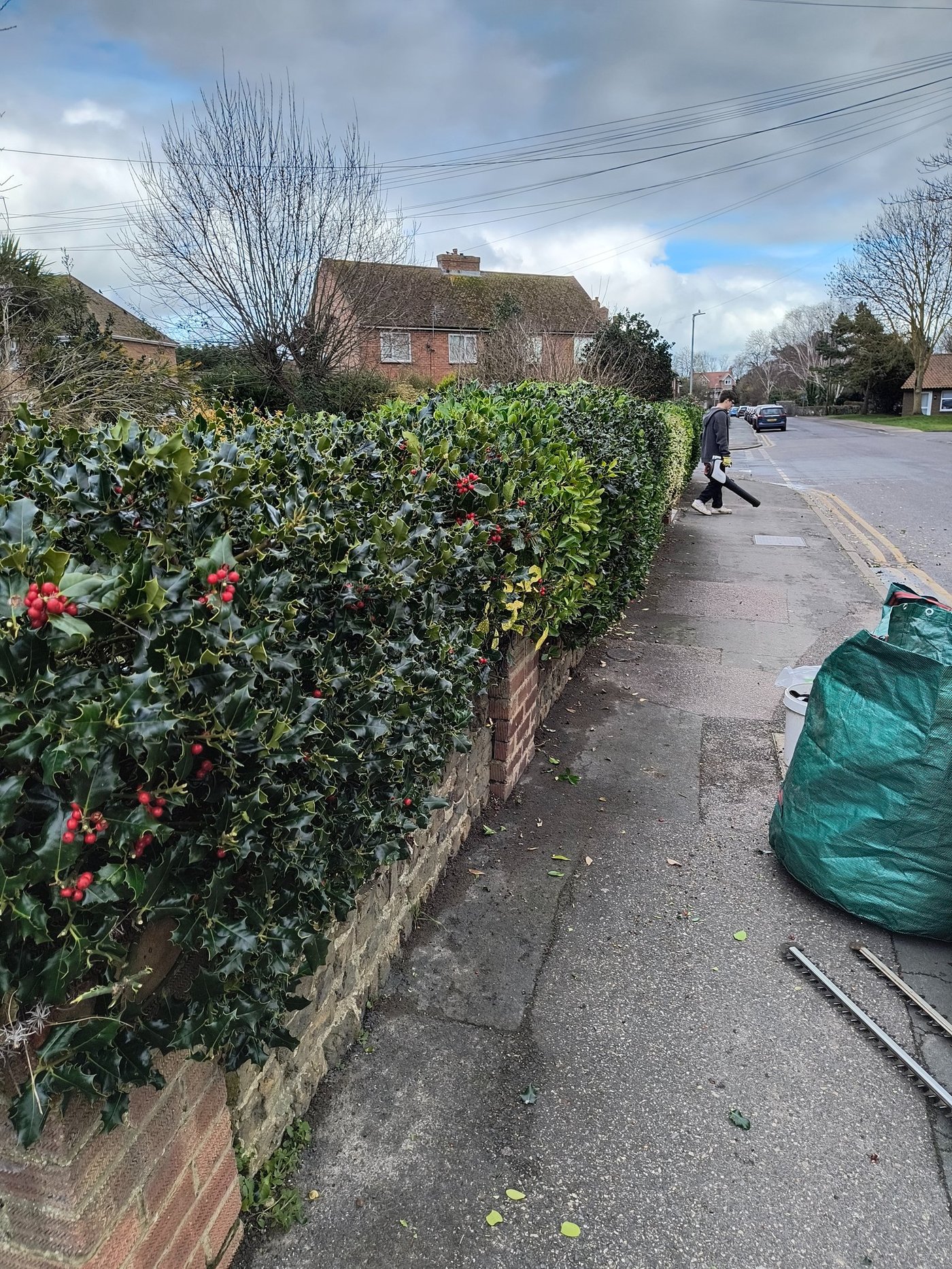
Laurel hedge care: quick checklist
- Use secateurs or loppers, not shears or a hedge trimmer on established growth, to avoid brown shredded leaf edges.
- Cut in late August to September for the main annual trim. A light tidy in June is fine if the hedge is empty of nesting birds.
- Check for active nests before cutting at any point between 1 March and 31 August.
- Cut in dry conditions. Working in wet weather spreads fungal disease between cuts.
- Dispose of trimmings properly. Laurel breaks down slowly and is best taken to a green waste facility, not added to a standard compost heap.
Cherry laurel (Prunus laurocerasus) is all over East Kent: a thick dark-green hedge in Sandwich gardens, lining paths in Woodnesborough, filling in the boundary in Worth. It earns its place. It grows readily in the coastal climate, tolerates shade that would kill most other hedge plants, and is almost impossibly hard to kill permanently.
The problem people most often run into is the same one every time: cutting it with a hedge trimmer and ending up with half-leaves that go brown along the cut edges. It looks as though something has gone wrong with the plant, but it is the tool that is wrong, not the hedge. The fix is straightforward.
1. Use secateurs or loppers, not a trimmer
Cherry laurel has large, glossy leaves, sometimes 15 to 20 centimetres long. When a hedge trimmer blade cuts through the middle of a leaf, the cut portion dies and turns brown within a couple of weeks. From a distance the hedge looks diseased or badly damaged. It is neither: the plant is fine, but every cut surface on every half-leaf is now dying.
Secateurs solve this. Cut back to a lateral branch, a leaf junction, or a bud, so there is no stump of leaf remaining. The hedge will look a little more open and airy immediately after cutting this way, but within a few weeks the new growth fills in cleanly with undamaged glossy leaves. The result over a full season is considerably better than trimmer-cut laurel.
For a very long run of laurel hedge (30 metres or more), cutting entirely by hand can take a long time. In that case, using a trimmer is a practical compromise, but accept that there will be brown edges for several weeks and plan to do the job again in spring once new growth has covered the cut surfaces.
2. Cut in late summer, after nesting season
Nesting season: do not cut without checking
The UK Wildlife and Countryside Act 1981 makes it an offence to damage or destroy an active bird's nest. Nesting season runs roughly 1 March to 31 August. Laurel is popular nesting cover for blackbirds, robins and wrens. The safe cutting window is September to February, with a light early-summer tidy acceptable only if you have checked the hedge thoroughly and it is clearly empty.
For most Kent gardens, the best time for the main laurel cut is late August to the end of September. Laurel puts on a lot of growth between June and September, so cutting in late August gives the plant time to push out one last set of growth before autumn, which hardens the new shoots and covers the cut surfaces before the cold arrives.
A second lighter pass in late May or June is worthwhile if the hedge has grown substantially since the previous autumn cut, but only if a thorough check confirms no active nesting.
3. Check for birds before you start
Laurel is dense enough that nests can be invisible from outside. Before starting, walk the length of the hedge and watch for birds flying in and out. If there is a blackbird clearly returning to the same spot in the hedge, or you can hear young birds, leave it. A few more weeks will not hurt the hedge. An active nest must not be disturbed.
Check from underneath too, pushing back branches gently and looking upwards. Once you are confident the hedge is empty, you can cut.
4. Work in dry conditions
Wet conditions when cutting laurel increase the risk of spreading fungal disease (particularly shot-hole disease, which causes small brown spots and holes in the leaves) between plants via wet tools and hands. Aim to cut on a dry day, and if you see signs of shot-hole on a laurel, clean your secateurs with a dilute disinfectant solution between plants rather than carrying spores through the whole hedge.
Burncoose Nurseries on pruning laurel
Burncoose Nurseries (established 1984, Cornwall, RHS-affiliated) produced a short video on pruning laurel hedges covering technique and tool choice: Pruning a laurel hedge on the Burncoose YouTube channel. Their approach aligns with what we do on laurel hedges across East Kent.
5. Dispose of trimmings properly
Laurel trimmings are bulky, slow to break down, and contain chemical compounds that can inhibit germination in a standard compost heap. The practical options are:
- Council green waste bin or bag. By far the easiest option for most households in Sandwich and the surrounding area.
- Skip hire with a green waste licence. For large renovation cuts producing a significant volume of material.
- Shredding. A good garden shredder can break laurel down to a material that will compost, but it does take considerably longer than softer hedge clippings. Run the shreddings through a separate hot-composting bay rather than the main heap.
Our guide on what to do with hedge trimmings covers the full range of options in more detail.
Renovating an overgrown laurel hedge
Laurel is one of the most forgiving hedges for renovation. It will respond to a very hard cut and shoot again vigorously within the same growing season. If a laurel hedge has got out of hand, late winter (February to early March) is the time to cut it back hard, before nesting season starts.
Cut back to the skeleton you want, give the hedge a balanced fertiliser in spring, and keep it watered in a dry spell. By summer it will be shooting well, and by the following year it will be presentable again. This is much less stressful than the equivalent renovation on leylandii or yew.
If height is the issue: the neighbour law angle
Laurel grows quickly, sometimes 30 to 60 centimetres a year in good conditions, and can easily exceed 2 metres if left for several seasons. If a neighbour's laurel hedge is blocking your light, the High Hedges provisions of the Anti-social Behaviour Act 2003 provide a route to ask the council to intervene. Our guide to hedge height law covers the process in plain English.
Before you start the cut: safety
Wear eye protection against flying fragments, gloves (laurel sap can irritate skin), and sturdy footwear. For tall hedges, use a long-reach pole trimmer from the ground rather than a ladder wherever possible. If a ladder is unavoidable, have someone footing it and never overreach sideways. Check the hedge for wasp nests before starting. If using a corded electric trimmer or secateurs near an extension lead, keep the cable behind you and visible at all times, and plug in via an RCD adaptor.
Rather we did it?
Laurel is one of the hedges we cut most often across Sandwich, Deal, Worth, Ash, Woodnesborough, Eastry and Sandwich Bay. Send a photo for a free quote. Most jobs booked in within the week.
Related guides
Looking after a privet hedge
How privet compares to laurel, and how to keep it dense and healthy through the year.
Read the guide Planting & choosingChoosing a hedge species for Kent gardens
How laurel compares to privet, beech, yew and other common choices for East Kent conditions.
Read the guide