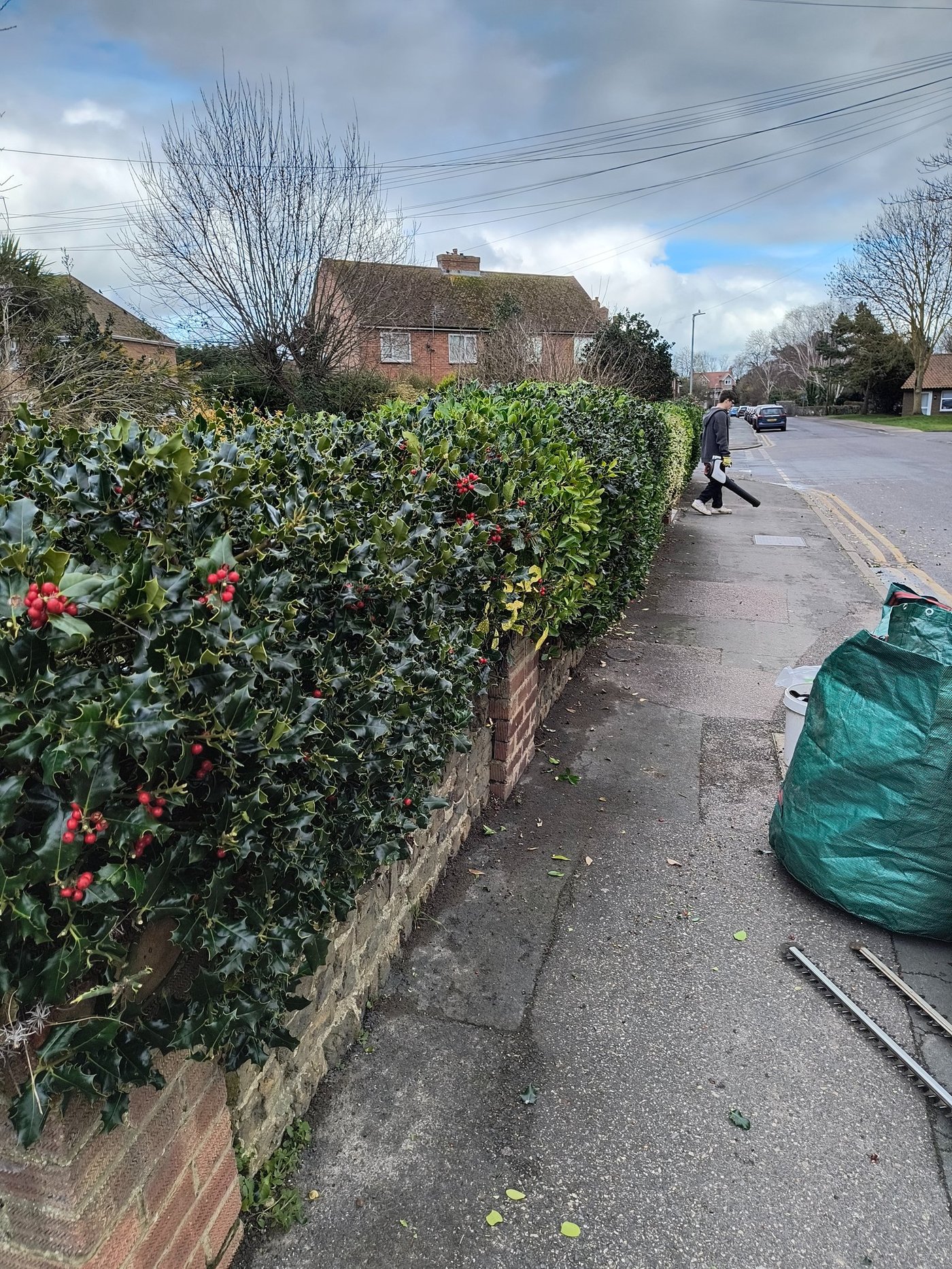
If you ask a nursery for laurel hedging, they will usually hand you cherry laurel (Prunus laurocerasus): the big-leaved, fast-growing plant that fills a boundary quickly and asks very little in return. Portuguese laurel (Prunus lusitanica) is the alternative they do not always mention, and in many situations it is the better choice.
We trim both species across Sandwich, Deal, Worth and Woodnesborough, and the questions about which one to use, and how they differ in care, come up regularly. Here is the honest comparison.
Portuguese laurel vs cherry laurel: the key differences
| Feature | Portuguese laurel | Cherry laurel |
|---|---|---|
| Scientific name | Prunus lusitanica | Prunus laurocerasus |
| Leaf size | Small-medium (5-10cm), oval, dark glossy green | Large (10-20cm), very glossy, pale green underside |
| Stem colour | Distinctive maroon-red | Green |
| Annual growth | 30-45cm per year | 60-90cm per year |
| Appearance | Formal, refined, suitable for tight hedges | Bolder, faster screening, less formal |
| Flowers | Fragrant white racemes, June | White racemes, April-May, less scented |
| Berries | Red then black, small clusters, autumn | Red then black, larger fruits |
| Frost hardiness | Hardy to around -15°C | Hardy to around -15°C |
| Trimmer suitability | Good: small leaves do not shred badly | Poor: large leaves shred and brown at cut edges |
| Best for | Formal hedges, smaller gardens, where growth rate needs managing | Fast screening, large boundaries, privacy quickly |
Which to choose for a Kent garden
Both thrive in Kent's mild coastal climate. The mild winters along the East Kent coast mean neither species suffers the foliage browning that harder inland frosts can cause.
Choose Portuguese laurel if: you want a formal, refined hedge that stays a manageable size; your garden is smaller and a hedge that grows 60-90cm a year would become a constant battle; or you want the June flower display and the wildlife value that comes with it.
Choose cherry laurel if: you need to establish a screen quickly; you have a large boundary to fill; or the informal, bold look suits the garden better. See our dedicated cherry laurel care guide for cutting technique and timing.
Nesting season
The UK Wildlife and Countryside Act 1981 makes it an offence to damage or destroy an active bird's nest. Nesting season runs roughly 1 March to 31 August. Portuguese laurel's June flowering period sits right in the middle of this window, which is one more reason to leave the main cut until September. If a second trim in late May is needed for a formal hedge, check the hedge for active nests first. The safe all-clear cutting window is September to February.
Before you start trimming
- Eye protection: safety glasses or goggles to keep clippings out of your eyes.
- Gloves: sturdy work gloves; the leaf stems can be a little rough.
- Electric trimmers and RCDs: always use a residual current device (RCD) with a corded trimmer, and keep the cable behind you.
- Ladders: a pole trimmer or long-reach shears is safer than a ladder for hedges over about 1.5m. If you must use a ladder, have someone footing it and do not overreach sideways.
- Wasp nests: part the outer foliage and look before you start.
When and how to trim Portuguese laurel
Once a year is usually enough. The main cut in late August or September keeps the hedge tidy going into winter and avoids the peak nesting period. September is ideal: nesting is over, the summer growth can be taken back, and the hedge has a few weeks to settle before winter.
A second lighter trim in late May, taking back only the spring growth flush, keeps a formal hedge crisper through summer. But because May is well within nesting season, check the hedge carefully first. If you spot a nest in use, leave that section and come back in September.
Portuguese laurel's smaller leaves mean a powered trimmer gives a clean finish without the shredded-leaf browning you get on cherry laurel. Keep the blades sharp. Hand shears give slightly more control on formal shapes or where the hedge meets a wall, but for a long run of hedge the trimmer is fine.
How hard can you cut?
Portuguese laurel regenerates well from old wood. For a hedge that has grown wider or taller than you want, cut back hard in late February or early March, before nesting season. Reduce the height and width by up to a third in one go; the hedge will reshoot from old stems within the same season.
For a very neglected hedge that needs more substantial reduction, spread the work over two winters. Take the top and one side back hard in year one; take the remaining sides back hard in year two. This keeps at least one face of the hedge green throughout and reduces the shock to the plant.
If a neighbour's Portuguese laurel hedge is a problem because it is blocking your light, see our guide to hedge heights and neighbour law for the legal position.
Flowers, berries and wildlife
Portuguese laurel earns its place in wildlife gardens as well as formal ones. The long, scented white flower racemes in June attract bees and other pollinators at a time of year when many hedging plants are not flowering. Leave the hedge uncut through summer (which you should be doing anyway, during nesting season) and the flowers develop into small berries that turn from red to near-black in autumn, attractive to thrushes, blackbirds and fieldfares visiting from the continent in a typical East Kent autumn.
Credit: the best4hedging channel's video "A focus on Portuguese Laurel: All you need to know about Prunus lusitanica hedging" covers the species' key characteristics and is produced by one of the UK's leading specialist hedging nurseries. Find it on YouTube by searching for that title or the channel name.
Rather we just trimmed it?
We cut laurel hedges of both types across Sandwich, Deal, Worth, Ash, Woodnesborough, Eastry and Sandwich Bay. Send a photo for a free quote, most jobs are booked within the week.
Related guides
Cherry laurel hedge care
The larger-leaved cousin. Tools, timing and the cutting technique that avoids the shredded-leaf look.
Read the guide Planting & choosingChoosing a hedge species for Kent gardens
Coastal, clay, chalk or shaded: what to plant depending on where you are in East Kent.
Read the guide