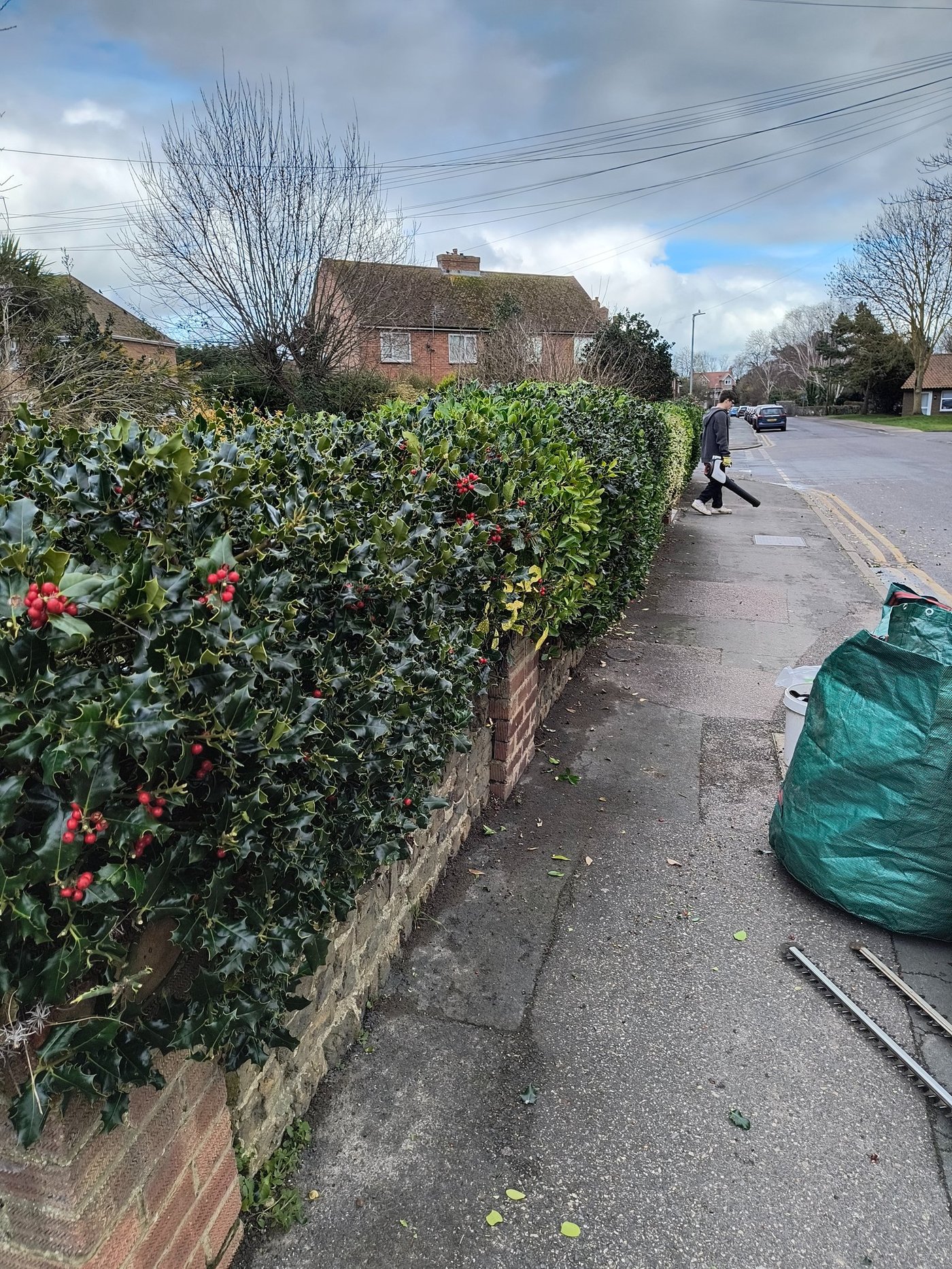
Pyracantha is one of those plants that looks after itself for most of the year and rewards benign neglect with a genuinely spectacular winter display. But it does have a specific timing problem: the window when you can trim it without ruining the berries is narrower than most people realise.
Cut too early in the season and you take the flowers. Cut in late summer and you remove the developing berries. Cut in October and you are stripping food from the fieldfares and redwings that have just crossed the North Sea to winter on the Kent coast. There is a right time and a wrong time, and they are not the same depending on whether you want a tidy hedge or a wildlife one.
Nesting season
The UK Wildlife and Countryside Act 1981 makes it an offence to damage or destroy an active bird's nest. Nesting season runs roughly 1 March to 31 August. Pyracantha's dense, thorny interior is some of the most popular nesting habitat in a suburban garden. Blackbirds, dunnocks and robins nest in it reliably. Always check thoroughly and carefully before any cut. The safe all-clear window is September to February, though early September nests are possible. See our full guide to when to trim hedges in Kent.
Before you start
- Thick gloves: pyracantha thorns are long, hard and sharp. Standard gardening gloves are not enough. Use thick leather gauntlets that cover the wrist.
- Eye protection: berries and clippings fly unpredictably when trimmed. Safety glasses or goggles are essential.
- Long sleeves: even brushing against pyracantha can draw blood. Cover your arms fully.
- Electric trimmers and RCDs: if using a corded trimmer, always plug in via a residual current device (RCD) and trail the cable away from your cutting direction.
- Ladder safety: pyracantha can grow tall fast. Use a stable platform ladder rather than a stepladder, and have someone footing it. A pole trimmer keeps you on the ground for hedges up to about 2.5 m.
- Disposing of trimmings: pyracantha clippings stay sharp for months. Double-bag or wrap before putting in a green bin, and do not leave them lying on a path or lawn where people walk barefoot.
When to trim: the berry question
Pyracantha flowers on short spurs that grow on the previous season's wood. This is the key fact that governs everything about timing. New extension growth also carries developing fruit clusters. Cut the extension shoots and you remove those berries.
Late February to March: the wildlife-friendly approach
This is the trimming window we recommend most often. By late February the birds have eaten or knocked off most of the berries, the hedge is outside the nesting season, and the spring growth has not yet started. You can cut back firmly, reshape the outline, and remove any dead or congested interior branches.
The hedge will go on to flower and berry again the same season. Established short spurs on old wood are not removed by a surface trim, so there will still be a berry display in autumn, though a very hard cut into old wood in this window will reduce it for one season.
Late June to early July: the shape-and-appearance compromise
If the hedge has put on a lot of soft extension growth by midsummer and looks untidy, a light clip in late June or early July, once the white flowers have faded, is a workable compromise. You will remove some of the developing fruit clusters on the trimmed shoots, but short spurs on established older wood will still carry berries through the autumn.
This cut works well for pyracantha trained against a wall or fence, where you want to keep it flat and tidy rather than let it billow outwards through summer.
What to avoid
Do not cut in April or May, when pyracantha is actively forming flower buds on the new growth. You will remove the flowers and therefore the berries entirely. Do not cut in September, October or November unless there is a compelling reason to do so: this is when the berries are at their peak and the birds most need them.
How to trim pyracantha
Long-handled loppers or a powered trimmer with long reach both work, but loppers give more control and keep your hands further from the thorns. Work from the sides of the hedge inwards rather than from directly above where clippings fall back onto you.
For a hedge trained flat against a wall, hand shears or a battery trimmer on a light setting give the most precision. Tie in any long shoots you want to keep rather than cutting them off; new extension shoots that are heading in the right direction can be shortened by a third and tied to the support.
Clear the clippings carefully. Pyracantha offcuts on a lawn or path are a genuine hazard. Use a tarpaulin underneath while you work so you can gather everything in one go.
Wildlife value in East Kent
Pyracantha gives something useful to wildlife in every season. In May and June the white flower clusters are worked by bees, hoverflies and other pollinators. The thorny interior is among the best nesting cover a garden hedge can offer, used reliably by blackbirds, dunnocks, robins and song thrushes.
From September the berries become a critical food source. Resident blackbirds and song thrushes start on them first. Then, typically from October in East Kent, the winter thrushes arrive. Fieldfares and redwings cross the North Sea from Scandinavia and make landfall along the Kent coast, often in large numbers at Sandwich Bay and Deal. A pyracantha hedge in a Deal or Sandwich garden in October can have a dozen fieldfares in it at once, the birds plucking berries methodically before moving on.
Starlings, house sparrows and mistle thrushes will also visit. By January or February most of the berry crop is gone, which is the signal that the hedge is ready to trim without causing any harm.
Renovation: cutting back an overgrown pyracantha hedge
Pyracantha grown as a free-standing hedge can reach 3 m or more if left uncut for several years. The good news is that it cuts back hard and regenerates reliably from old wood.
Tackle renovation in late February or early March. Cut the sides back to the desired outline and reduce the height to where you want it. You can remove up to half the volume in one go. Clear the interior of dead branches and anything crossing or rubbing. Follow with a general-purpose slow-release fertiliser applied around the base and water during any dry spells in the following spring and summer.
The hedge will produce some flowers and berries in the first season after a hard renovation, but the full display usually returns in the second year as the new growth matures and develops fruiting spurs.
In the mild East Kent coastal climate, pyracantha recovers quickly. We have cut back pyracantha hedges in gardens across Sandwich, Worth and Woodnesborough that had not been touched for four or five years, and within two seasons they were back to a full berry crop.
If you want the berries, leave the hedge alone from June to February and let the birds decide when the season is over. That is the simplest rule for pyracantha in Kent.
Credit: the best4hedging channel's video "A Focus On Pyracantha: All you need to know" is an excellent introduction to growing and maintaining Pyracantha hedging from one of the UK's leading specialist hedging nurseries. You can find it on YouTube by searching for that title or the channel name.
Rather we handled it?
We trim and renovate hedges across Sandwich, Deal, Worth, Ash, Woodnesborough, Eastry and Sandwich Bay. Send a photo for a free quote, most gardens booked the same week.
Related guides
Hawthorn hedge care in Kent
The most wildlife-rich hedge plant in Britain. When to cut, how to navigate the berry season, and the decision between annual and biennial trimming.
Read the guide WildlifeWildlife-friendly hedge trimming
Nesting birds, hibernating hedgehogs and the law that protects both. When to cut, and when to wait.
Read the guide