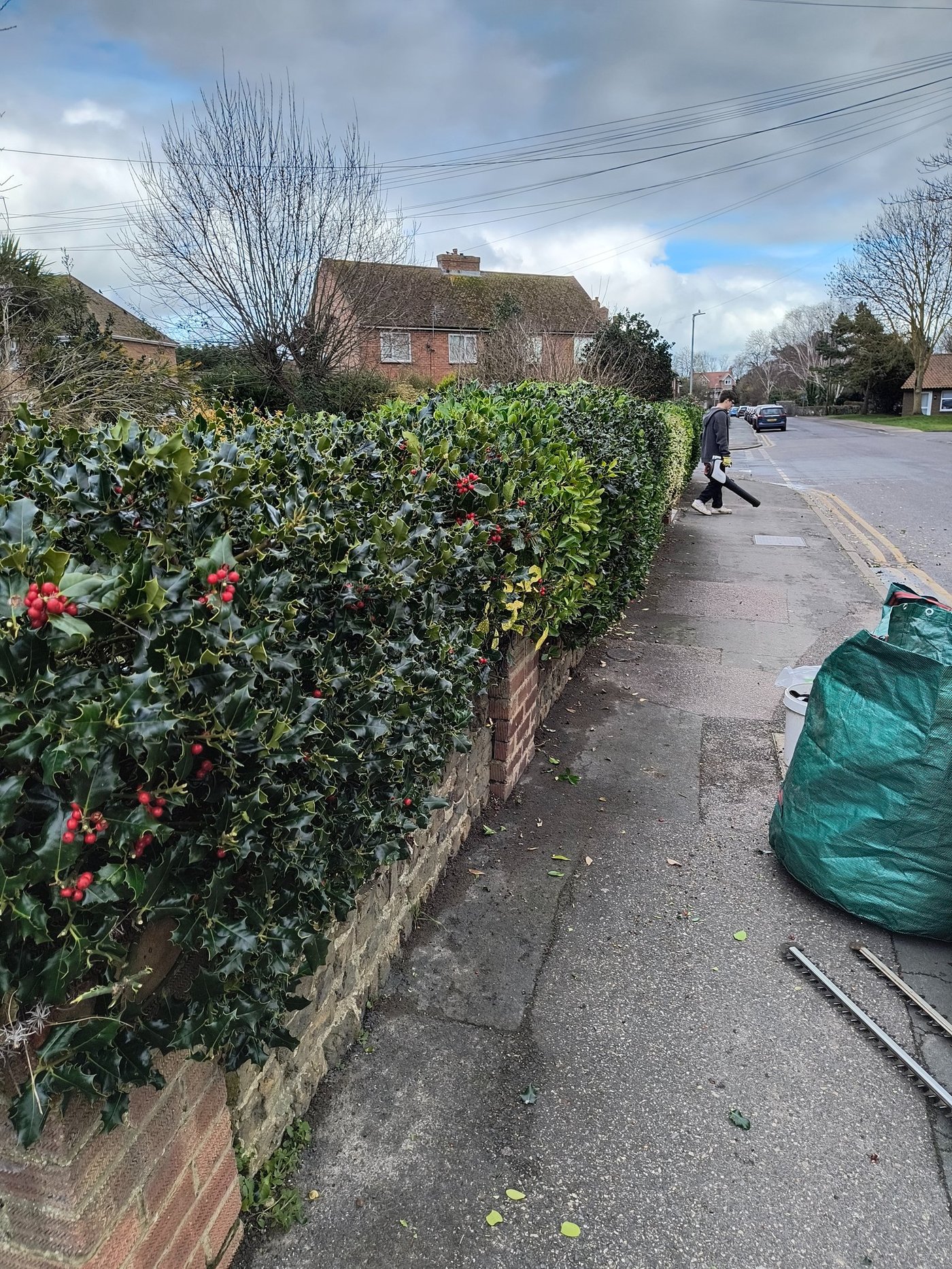
Most Kent gardens have at least one hedge, and most Kent hedges get aphids at some point. For the majority of established hedges in Sandwich, Deal, Worth and the surrounding villages, a spring aphid infestation is an inconvenience rather than a crisis. But it does help to know what you are looking at.
This guide works through the most common signs and matches them to a type, then explains which response actually helps and which does more harm than good.
What does an aphid problem look like? Work through these
The leaves feel sticky to the touch, and there may be black sooty patches lower down.
Sticky deposits are honeydew: a sugary waste product excreted by aphids feeding on the sap above. The black patches are sooty mould growing on the honeydew, not a fungal infection of the plant itself. Both are signs of an active aphid population, usually feeding on new growth higher up.
You can see small clusters of soft-bodied insects, often greenish, pale yellow or black, on new shoots and the undersides of young leaves.
These are the aphids themselves. If they are moving, the colony is still active. If they are all dead-looking and brown, natural predators may already have dealt with the worst of it.
New growth is curling inward or looking distorted.
Aphids inject a toxin as they feed that causes leaf curl, particularly on privet and honeysuckle-type hedging. The curled leaves protect the colony inside them. Getting a spray into curled leaves is almost impossible, which is why catching an infestation early (before the leaves curl around it) makes treatment much easier.
You can see white, fluffy, cottony patches on the bark or stems of a beech hedge.
This is woolly beech aphid (Phyllaphis fagi), one of the most distinctive and common summer sights in East Kent beech hedges. The fluffy white coating is a waxy secretion the aphid uses as protection. The aphids sit on the undersides of leaves, and the honeydew they produce falls and makes lower leaves sticky.
Aphids you are most likely to find on East Kent hedges
Woolly beech aphid
Appears from May onwards on beech (Fagus sylvatica) hedges. White, fluffy, and easy to spot. Produces heavy honeydew. Numbers typically peak in June and then decline naturally as parasitic wasps and ladybirds move in. Beech hedges in Sandwich Bay and along the Deal seafront get this regularly; the mild winters mean the aphid overwinters more successfully than in colder parts of the country.
Privet aphid
A pale yellow-green aphid that feeds on privet (Ligustrum) and, occasionally, ash trees. Causes leaf yellowing and some distortion on young shoots. Common from May to July. The aphids tend to cluster on shoot tips and the underside of young leaves.
Black bean aphid
Most often seen on elder but also appears on viburnum, philadelphus and occasionally other hedging shrubs. Dense, black clusters on the tips of young growth in late spring. Numbers can build very fast in warm weather.
Rose-grain aphid
Pinkish-cream aphid that appears on hawthorn, roses and sometimes blackthorn hedges in spring. Usually mobile and hard to spot until numbers are high.
Scale insects: not aphids but worth knowing
If you see flat, brown, limpet-like bumps on stems rather than soft-bodied insects, those are scale insects, a different pest entirely. They also produce honeydew. Common on laurel, euonymus and cotoneaster. Treatment is different: a winter wash of plant oil or a systemic insecticide is more effective than water spray for scale.
What to do about hedge aphids
Work through this in order, starting with the least intervention:
Step 1: A strong jet of water
The RHS recommends this as the first response, and it works. A hosepipe with a good nozzle, directed at the undersides of leaves and at clusters on new growth, dislodges most aphids and breaks up the colony. Do it in the morning so the foliage dries before evening. Repeat two or three times a week while numbers are high. On a woolly beech aphid infestation, this removes both the aphids and the protective wax coating.
Step 2: Leave it for natural predators
Aphids have a lot of natural enemies: ladybirds and their larvae, lacewing larvae, hoverfly larvae, parasitic wasps, blue tits and sparrows. On a healthy hedge in a garden with some diversity of planting, these predators often deal with an aphid infestation faster than any spray would. If numbers are not rising fast and the hedge is established, waiting a fortnight before doing anything more is often the right call.
Step 3: Insecticidal soap or fatty acid spray
If the infestation is heavy or on a young hedge that cannot afford to lose sap, an organic insecticidal soap or fatty acid spray is effective. Spray the underside of leaves as well as the top surface. These products work on contact and break down quickly, leaving no persistent residue. Do not spray when the hedge is in flower, as this harms pollinators. Apply in the evening to reduce the risk of burning foliage.
Step 4: Systemic insecticide (last resort)
Systemic insecticides are taken up into the plant's sap and kill aphids that feed on it. They are effective but non-specific: they also kill beneficial insects, including pollinators, that visit a treated plant in flower. The RHS and most conservation bodies recommend avoiding these products in garden settings unless all other options have failed. Never use a systemic insecticide on a hedge in flower.
Preventing aphids coming back
You cannot eliminate aphids from a garden, and you would not want to, because the caterpillars, hoverflies and blue tits that eat them are part of a garden ecosystem. What you can do is reduce the conditions that let infestations build:
- Avoid over-feeding with nitrogen. High-nitrogen fertilisers produce soft, sappy growth that aphids prefer. Use a balanced slow-release feed rather than a straight nitrogen feed in spring. See our guide to feeding hedges for the detail.
- Keep the hedge well trimmed. Dense, overgrown hedges with lots of soft interior growth are more aphid-prone than a well-maintained hedge that gets regular light cuts.
- Encourage predators. A garden with some diversity, a few flowering plants near the hedge, some nettles somewhere, a log pile, makes life harder for aphid colonies and easier for the things that eat them.
- Water in dry spells. A hedge under drought stress is more vulnerable to pest attack. In East Kent, where chalk and sandy coastal soils drain fast, a dry spring can leave even established hedges under moisture stress by June. See our guide to hedge care in summer and drought.
The RHS has a useful video on aphid identification and management on their YouTube channel, "How to deal with Aphids in your garden", at youtube.com/watch?v=20VSDwMiOL4. The RHS channel carries over 78,000 subscribers and is one of the most reliable sources of practical UK horticultural guidance available online.
Should you call someone in?
For the average established beech or privet hedge in a Kent garden, no. The water-jet approach and a bit of patience handles most infestations. Where we do get called is when a hedge looks generally unwell, growth is patchy or yellowing across a whole section, and the customer is not sure whether aphids are the cause or a symptom of something else going on. If the hedge is declining, it is worth having a look at whether there is a root issue, a soil pH problem, or a drainage issue making it vulnerable in the first place. Get in touch if you are not sure.
Got hedge problems you cannot diagnose?
We are out cutting hedges across Sandwich, Deal, Worth, Ash, Woodnesborough, Eastry and Sandwich Bay. If your hedge looks wrong and you are not sure why, send us a photo and a description. We will tell you what we think.